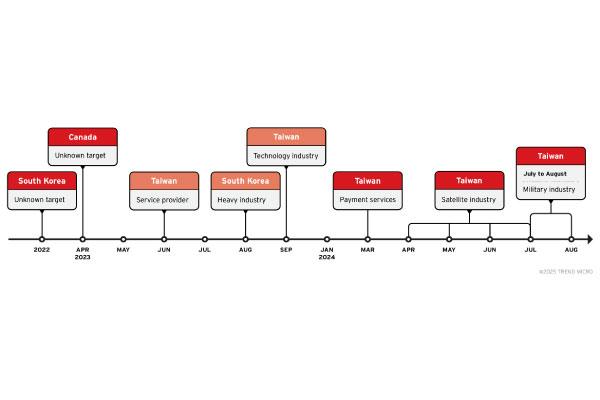
A cyber espionage group known as Earth Ammit has been linked to two related campaigns—VENOM and TIDRONE—conducted between 2023 and 2024, targeting critical sectors in Taiwan and South Korea. These sectors include military, satellite, heavy industry, technology, software services, media, and healthcare. Cybersecurity firm Trend Micro attributes the campaigns to a Chinese-speaking nation-state actor. VENOM focused on software service providers, while TIDRONE zeroed in on the military and drone manufacturing supply chains. In the VENOM campaign, Earth Ammit exploited web server vulnerabilities to deploy web shells and install remote access tools like REVSOCK and Sliver. The only custom malware identified was VENFRPC, a modified version of the open-source FRP proxy tool. The goal was to compromise trusted supply chains and pivot downstream to high-value targets. Credential harvesting and long-term persistence were key objectives, setting the stage for the more targeted TIDRONE campaign. TIDRONE followed a structured three-stage approach: initial access by compromising service providers, command-and-control using DLL loaders to deliver CXCLNT and CLNTEND backdoors, and post-exploitation through privilege escalation, antivirus evasion using TrueSightKiller, and data collection with tools like SCREENCAP. CXCLNT, in use since 2022, supports modular plugins, while CLNTEND, first seen in 2024, expands on its capabilities to better evade detection. The shared infrastructure and victims suggest a single threat actor behind both campaigns, with TTPs resembling those of the Chinese group Dalbit. Separately, a campaign dubbed Swan Vector, targeting entities in Taiwan and Japan with spear-phishing emails and fake resumes, has also been attributed to an East Asian actor using malware like Pterois and Isurus to deliver Cobalt Strike.
Cybercriminals are now weaponizing legitimate hotel reservation data to trick travelers into surrendering their payment details. This "Reservation Hijack Scam" stands out b...
A serious security issue has been discovered in nginx-ui, which can allow attackers to take full control of a system. This vulnerability is tracked as CVE-2026-33026. The problem e...
A sophisticated phishing campaign is targeting Spanish speaking users across Latin America and Europe, aiming to deploy Windows banking malware such as Casbaneiro (also known as Me...