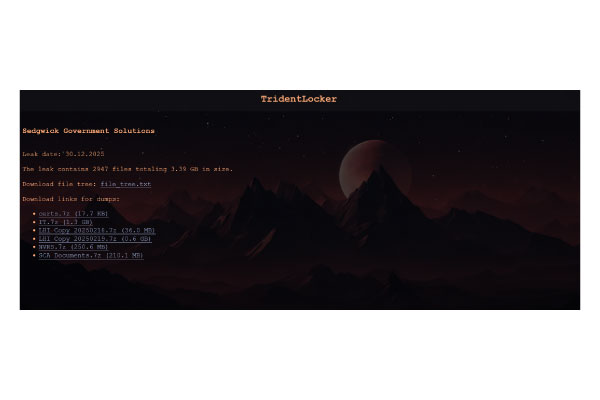
Sedgwick has disclosed a cybersecurity incident affecting its federal contracting subsidiary, Sedgwick Government Solutions, following a claim by the TridentLocker ransomware group that it accessed and exfiltrated internal data. The activity was reportedly detected around the end of December, when the threat actor alleged it had obtained approximately 3.4 GB of files. Sedgwick stated that the incident was limited in scope and that it promptly initiated its incident response procedures after identifying suspicious activity. The company also confirmed that relevant authorities and affected stakeholders were notified as part of its response. According to Sedgwick, the intrusion involved an isolated file transfer environment used by its government solutions unit, which is architecturally separated from the organization’s core claims management and enterprise systems. External cybersecurity specialists were engaged to conduct a forensic investigation and assess whether the attacker achieved persistence or lateral movement. While TridentLocker is known for employing double-extortion techniques—combining data theft with ransomware encryption—Sedgwick has not confirmed that production systems were encrypted or that a ransom demand was formally issued. At this stage, the company maintains that there is no evidence indicating broader compromise beyond the specific environment under review. TridentLocker is a relatively new ransomware-as-a-service operation that surfaced in late 2025 and has rapidly adopted data-leak extortion as a pressure tactic. Although the group publicly claimed responsibility, Sedgwick emphasized that its investigation is ongoing and that conclusions regarding the authenticity and sensitivity of the alleged data remain under evaluation. The incident highlights the continued targeting of service providers and government-adjacent organizations by emerging ransomware groups seeking reputational leverage and financial gain through data exposure.
A critical vulnerability has been identified in PX4 Autopilot, widely used in drones and autonomous vehicles across global industries. Highlighted by Cybersecurity and Infrastructu...
Cybercriminals are now weaponizing legitimate hotel reservation data to trick travelers into surrendering their payment details. This "Reservation Hijack Scam" stands out b...
A serious security issue has been discovered in nginx-ui, which can allow attackers to take full control of a system. This vulnerability is tracked as CVE-2026-33026. The problem e...