


DPDP Act Compliance Services help organizations meet the requirements of India's DPDP Act 2023 & DPDP Rules 2025 through a structured DPDPA Gap Assessment, privacy governance design, and a prioritized implementation roadmap - covering data mapping, consent management, security controls, and Data Principal rights.
The Digital Personal Data Protection (DPDP) Act, 2023 is India's primary data privacy law governing how organizations collect, process, store, share, transfer, and protect digital personal data. It applies to every Data Fiduciary and Data Processor handling the personal data of individuals in India and establishes the rights of every Data Principal, including the right to access, correct, erase personal data, withdraw consent, and seek grievance redressal. Organizations that fail to comply with the DPDP Act may face significant financial penalties and regulatory action.
The DPDP Rules, 2025 operationalize the Act by defining how organizations must implement privacy notices, consent management, data retention, security safeguards, breach reporting, cross-border data transfers, and additional obligations for Significant Data Fiduciaries. Together, the DPDP Act 2023 and the DPDP Rules 2025 establish India's complete legal and operational framework for digital personal data protection and privacy compliance.
At Varutra, our DPDP Compliance Services help organizations achieve end-to-end compliance through DPDP Gap Assessments, privacy governance, personal data discovery and mapping, consent management, policy development, Data Principal rights implementation, privacy risk assessments, security control reviews, and a practical compliance roadmap aligned with the requirements of the DPDP Act 2023 and the DPDP Rules 2025.
What We Help You Achieve
Complete assessment of your compliance posture under the DPDP Act 2023 & DPDP Rules 2025, a practical implementation roadmap, stronger governance, and long-term compliance readiness.

DPDP Act 2023 &
DPDP Rules 2025
Practical Implementation Guide
Learn how to implement the Digital Personal Data Protection (DPDP) Act 2023 and DPDP Rules 2025 using a practical roadmap covering privacy governance, consent management, data mapping, security safeguards, breach response, Data Principal rights, and organizational compliance readiness.
DPDP Act 2023 vs DPDP Rules 2025
Understanding the difference between the DPDP Act 2023 and the DPDP Rules 2025 is essential for every organization processing personal data in India. The DPDP Act establishes the legal framework for digital personal data protection, while the DPDP Rules define how organizations must implement those legal requirements through operational controls, governance, and compliance practices.
Quick Answer: The DPDP Act 2023 defines organizations are legally required to do, while the DPDP Rules 2025 explain how those requirements must be implemented. Organizations must comply with both to achieve effective DPDP compliance.
| Aspect | DPDP Act 2023 | DPDP Rules 2025 |
|---|---|---|
| Purpose | Defines the legal framework, rights, obligations, and penalties. | Specifies implementation procedures, timelines, and operational requirements. |
| Scope | Covers Data Fiduciaries, Data Processors, Data Principals, Significant Data Fiduciaries, and legal obligations. | Covers notices, consent management, grievance handling, security safeguards, breach reporting, and data retention. |
| Primary Focus | Explains what organizations are legally required to do. | Explains howorganizations should achieve compliance. |
| Compliance Requirements | Provides high-level legal obligations and statutory responsibilities for protecting personal data. | Defines operational controls, documentation, consent workflows, implementation procedures, and compliance timelines. |
| Business Impact | Determines legal applicability and consequences of non-compliance. | Provides the operational framework for day-to-day compliance implementation. |
Key Takeaway: The DPDP Act 2023 establishes the legal requirements for protecting digital personal data, while the DPDP Rules 2025 provide the practical implementation framework. Together, they enable organizations to build effective privacy governance, implement compliant data processing practices, and maintain continuous DPDP compliance.
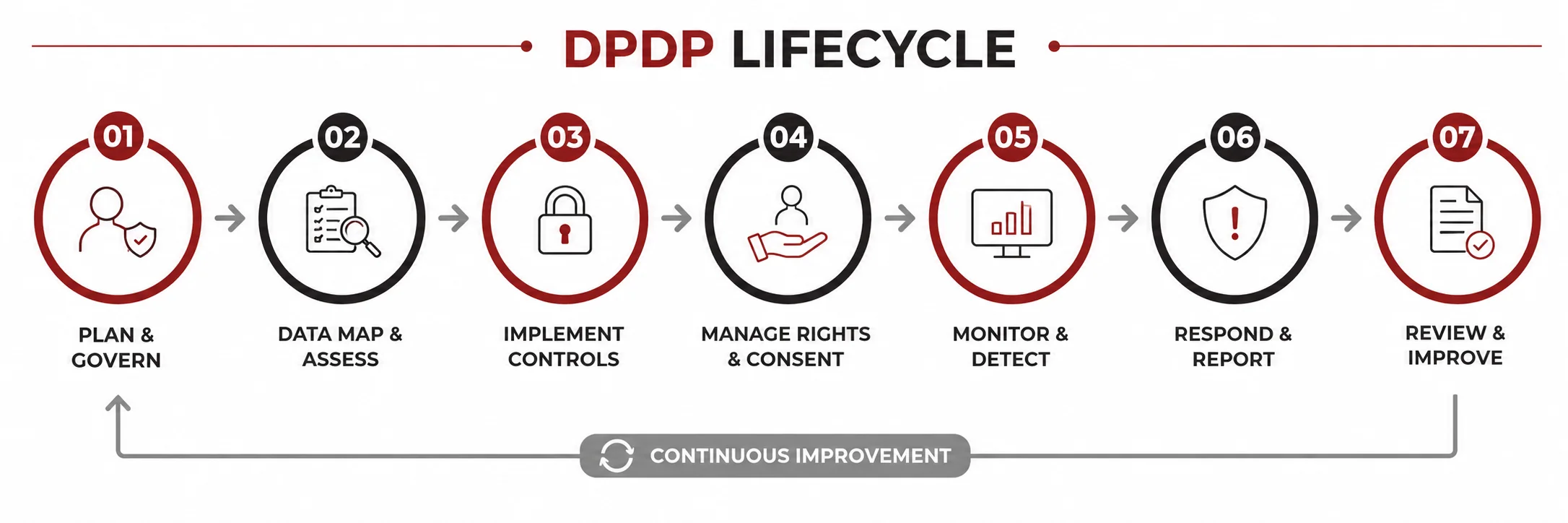
Comprehensive Services for DPDP Act 2023 & DPDP Rules 2025 Readiness
Our consulting team supports organizations at every stage of the DPDP compliance lifecycle - from initial assessment and gap analysis to implementation, governance, monitoring, and continuous advisory support.
DPDP Gap Assessment & Compliance Readiness
We evaluate your organization's current privacy posture against the DPDP Act 2023 & DPDP Rules 2025 and identify gaps across governance, policies, operations, technology, and risk management.
Privacy Governance, Policies & Documentation
We design accountability structures, roles, and oversight, and develop the privacy policies, notices, and SOPs organizations need to operate compliantly.
Data Discovery, Mapping & Classification
We identify and classify personal data across applications, databases, cloud environments, and third-party systems, and document its flow, storage, and lifecycle handling.
Consent Management & Data Principal Rights
We implement consent collection, withdrawal, and recordkeeping, and establish processes for access, correction, erasure, and grievance handling under the Act & Rules.
Privacy Impact & Third-Party Risk Assessment
We assess privacy risks in new processes, products, and vendor relationships, and recommend mitigation measures that strengthen accountability across your supply chain.
Security Control Assessment & Employee Awareness
We review technical safeguards such as access control, encryption, logging, and incident handling, and deliver role-based privacy training for your teams.
A Structured, Risk-Based Approach to Compliance
Our methodology combines discovery, assessment, prioritization, implementation planning, and validation so organizations can move from readiness to sustainable compliance with clarity.
Hover or tap a step title to expand it and see full details
- Step 01 Discovery & Scoping
Before any DPDPA gap assessment begins, we build a clear picture of your data ecosystem, applicable regulatory obligations, and project objectives.
- Stakeholder interviews across legal, IT & business teams
- Review of applicable DPDP Act 2023 & DPDP Rules 2025 obligations
- Define assessment scope, systems & timelines
- Step 02 Data Discovery & Privacy Assessment
We locate and document personal data across your technology landscape to build an accurate foundation for every compliance decision that follows.
- Identify data assets across apps, databases & cloud
- Map data flows from collection to deletion
- Classify sensitive & high-risk personal data
- Step 03 Gap Assessment & Compliance Review
We benchmark your governance, consent, vendor, and security practices directly against DPDP Act 2023 & DPDP Rules 2025 requirements to identify precise compliance gaps.
- Review governance & accountability structures
- Evaluate consent mechanisms & lawful basis
- Assess third-party & vendor privacy risk
- Step 04 Risk Analysis & Prioritization
Every identified gap is scored by regulatory exposure and business impact so remediation effort goes exactly where it matters most.
- Score gaps by likelihood & business impact
- Flag high-exposure regulatory risks
- Build a risk register for leadership visibility
- Step 05 Implementation Roadmap
We translate findings into a practical, phased roadmap that your teams can execute without disrupting day-to-day business operations.
- Define governance & policy improvements
- Plan technology & security enhancements
- Set milestones aligned to compliance deadlines
- Step 06 Validation & Knowledge Transfer
Once controls are implemented, we validate their effectiveness and equip your internal teams to sustain DPDP Act 2023 & DPDP Rules 2025 compliance independently.
- Conduct follow-up assessments & control testing
- Deliver executive reporting & compliance dashboards
- Transfer knowledge for continuous monitoring
Executive-ready outputs for leadership, compliance, and operations
- Executive Compliance Summary
- DPDP Act 2023 & DPDP Rules 2025 Gap Assessment Report
- Compliance Readiness Assessment
- Privacy Governance Framework
- Data Discovery & Data Flow Mapping
- Risk Register with Prioritized Findings
- Compliance Implementation Roadmap
- Management Presentation & Compliance Dashboard
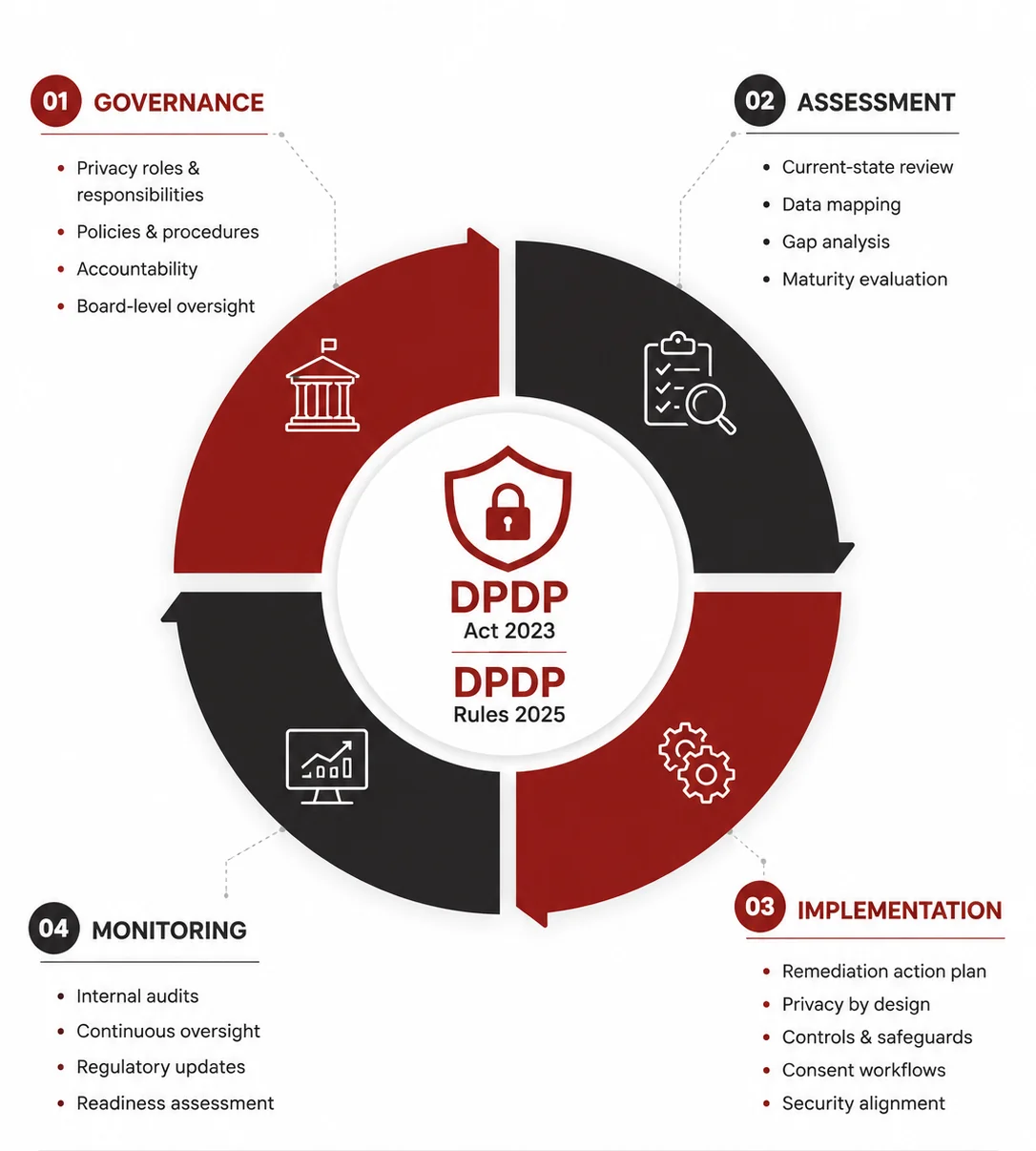
Expertise That Blends Privacy Governance and Cybersecurity
We combine deep technical knowledge with practical risk management to help organizations implement compliance that is both efficient and sustainable.
Privacy and Cybersecurity Expertise
Our consultants combine deep cybersecurity knowledge with privacy governance expertise, enabling organizations to strengthen both compliance and security.
Practical Compliance Approach
We deliver actionable recommendations that align regulatory requirements with operational realities, making implementation efficient and sustainable.
Risk-Based Assessments
Our methodology prioritizes the highest-risk compliance gaps first, helping organizations maximize security investments while reducing regulatory exposure.
Comprehensive Privacy Services
From gap assessments to implementation, governance, privacy impact assessments, security reviews, employee awareness, and ongoing advisory, we support the complete privacy compliance lifecycle.
Who Must Comply with the DPDP Act 2023?
Any organization that collects, stores, processes, shares, or transfers the personal data of individuals in India are required to comply with the DPDP Act 2023 and the DPDP Rules 2025. This includes organizations across the following industries.
- Banking, Financial Services & Insurance (BFSI)
- Healthcare & Life Sciences
- Information Technology (IT) & SaaS
- E-commerce & Retail
- Manufacturing & Industrial
- Telecommunications
- Education & EdTech
- Government & Public Sector
- Hospitality & Travel
- Logistics & Supply Chain
- Energy & Utilities
- Professional Services
- Media & Entertainment
- Startups & Digital Businesses
- Organizations Processing Personal Data
- Banking, Financial Services & Insurance (BFSI)
- Healthcare & Life Sciences
- Information Technology (IT) & SaaS
- E-commerce & Retail
- Manufacturing & Industrial
- Telecommunications
- Education & EdTech
- Government & Public Sector
- Hospitality & Travel
- Logistics & Supply Chain
- Energy & Utilities
- Professional Services
- Media & Entertainment
- Startups & Digital Businesses
- Organizations Processing Personal Data
Build a Stronger Privacy Program with Measurable Business Value
Identify regulatory gaps before they become issues.
Proactively resolve compliance gaps before they escalate into legal or operational exposure.
Strengthen privacy governance across operations.
Create a governance foundation that supports accountability, transparency, and consistent decision-making.
Improve visibility into personal data.
Use discovery and mapping to understand data flows, storage locations, and processing practices.
Enhance customer trust and compliance readiness.
Demonstrate responsible data handling practices that improve customer confidence and regulatory preparedness.
Answers to Common DPDP Questions
Straight answers to the questions we hear most from compliance, legal, and security teams evaluating readiness under the DPDP Act 2023 & DPDP Rules 2025.
- What is DPDP Compliance?
DPDP Compliance is the process of implementing the legal, governance, technical, and operational requirements of the DPDP Act 2023 and the DPDP Rules 2025 to ensure the lawful collection, processing, storage, sharing, protection, and disposal of digital personal data while safeguarding the rights of Data Principals.
- What is Included in a DPDP Gap Assessment?
A DPDP Gap Assessment evaluates your organization's current privacy and data protection practices against the requirements of the DPDP Act 2023 and the DPDP Rules 2025. It typically reviews governance, policies, data discovery and mapping, consent management, security controls, third-party risks, employee awareness, and compliance documentation to identify gaps and prioritize remediation.
- What is the Difference Between a Data Fiduciary and a Data Processor?
A Data Fiduciary determines the purpose and means of processing personal data and is responsible for complying with the DPDP Act 2023. A Data Processor processes personal data on behalf of a Data Fiduciary in accordance with contractual obligations and applicable legal requirements.
- Why are Data Discovery and Data Mapping Important for DPDP Compliance?
Data discovery and data mapping help organizations identify where personal data is collected, stored, processed, shared, and retained. This visibility supports consent management, Data Principal rights, privacy governance, security controls, and regulatory compliance under the DPDP Act 2023 and the DPDP Rules 2025.
- What Deliverables Will I Receive After a DPDP Compliance Assessment?
A typical DPDP Compliance Assessment includes an executive summary, compliance gap assessment report, privacy governance recommendations, data inventory and mapping, risk assessment, prioritized remediation plan, implementation roadmap, and guidance for achieving and maintaining compliance with the DPDP Act 2023 and the DPDP Rules 2025.
- How is the DPDP Act Different from the GDPR?
Both the DPDP Act 2023 and the EU GDPR regulate the protection of personal data and promote accountability. However, the DPDP Act is India's data protection law with its own legal framework, terminology, enforcement mechanisms, and compliance requirements, while the GDPR applies within the European Union and has broader extraterritorial provisions.
- What are the Penalties for Non-Compliance with the DPDP Act 2023?
The DPDP Act 2023 empowers the Data Protection Board of India to impose significant financial penalties for violations such as failure to implement reasonable security safeguards, failure to report personal data breaches, non-compliance with Data Principal rights, or other breaches of the Act. Organizations should establish effective privacy governance, security controls, and compliance processes to reduce regulatory risks and demonstrate accountability.
Start Your DPDP Act 2023 & DPDP Rules 2025 Gap Assessment Today
Get a clear, prioritized view of your organization's compliance posture under the DPDP Act 2023 & DPDP Rules 2025 - and a practical roadmap to close the gaps.
Free DPDP Gap Assessment
Q 1. How does your organization collect consent for processing personal data?
Q 2. Can Data Principals withdraw consent as easily as they provided it?
Q 3. Do you provide a standalone privacy notice at the point of personal data collection?
Q 4. Has your organization identified where personal data is collected, stored, processed and shared?
Q 5. Do you have visibility into where personal data (PII) is collected, stored and processed across your organization?
Q 6. Have you defined the personal data lifecycle, including retention and secure disposal requirements?
Q 7. What level of encryption protects personal data in your organization?
Q 8. How is access to personal data controlled within your organization?
Q 9. Do you have a documented incident response plan for personal data breaches?
Q 10. How prepared is your organization to notify regulators and affected individuals following a personal data breach?
Q 11. How are Data Principal access requests handled?
Q 12. How are requests for correction or deletion of personal data handled?
Q 13. If your organization processes children's personal data, how is verifiable parental consent obtained?
Q 14. How does your organization govern cross-border transfers of personal data?
Download DPDP Whitepaper (Free)
We respect your privacy. Your information will be kept confidential and handled securely.