
Cybersecurity Services for Technology, IT & ITES Companies
Protect your technology, IT or ITES business with risk-based cybersecurity services for applications, SaaS platforms, APIs, cloud environments, infrastructure and digital services. Varutra helps identify cyber risk, strengthen security controls and build measurable cyber resilience.
Securing each IT sector
Cybersecurity services for each of the business models shown below.
IT SERVICES
Managed services, consulting, system integration and technology delivery organizations
SOFTWARE & SaaS
Software products, SaaS platforms, applications, APIs and digital product businesses
ITeS & BPM
Business process management, BPO, KPO, shared services and technology-enabled operations
ENGINEERING & R&D
Engineering services, product development, embedded technology and R&D environments
FINTECH & DIGITAL
Digital platforms, fintech products, online services and technology-led business models
CLOUD & DATA CENTRES
Cloud workloads, hosting environments, data centres, infrastructure and critical platforms
TELECOM & NETWORKS
Telecom operators, network providers, communications platforms and connected infrastructure
GCCs & CAPTIVE CENTRES
Global capability centres, captive technology teams and enterprise shared technology operations
IT cybersecurity protects the applications, data, cloud environments, infrastructure and digital services that modern businesses rely on, helping reduce cyber risk and strengthen resilience against evolving threats.
The modern attack surface spans web and mobile applications, APIs, cloud environments, networks, identities, data, development pipelines, third-party technologies, connected systems, and more. These interconnected environments can create vulnerabilities that lead to unauthorized access, data exposure, service disruption and software supply-chain risks.
Varutra helps organizations identify and reduce these risks through VAPT of - Applications, APIs, cloud and infrastructure. We also provide continuous monitoring, incident response, GRC and strategic security advisory.
Because applications, APIs, cloud services, identities, infrastructure and software dependencies are interconnected. A weakness in one layer can create access to other systems, expose data or disrupt digital services. Cybersecurity helps identify, validate and reduce those risks.
Why Do IT Companies Need Cybersecurity?
Rapid software delivery, cloud adoption, connected services and third-party dependencies expand the attack surface. Security programs need to address technical weaknesses and the business impact of compromise.
Application & API Exposure
Broken access controls, insecure business logic, injection, authentication weaknesses and API abuse can expose applications and sensitive data.
Cloud & Identity Risk
Misconfiguration, excessive privilege, exposed services and weak identity controls can create paths into cloud workloads and data.
Credential & Account Abuse
Phishing, credential theft, session abuse and privilege misuse can turn a single compromised account into wider enterprise access.
Software Supply Chain
Dependencies, libraries, build systems, third-party integrations and CI/CD services can introduce security risk into software delivery.
Infrastructure Exposure
Weak network controls, vulnerable systems, insecure configurations and remote-access pathways can increase attack surface.
Third-Party & Business Risk
Technology providers, outsourcing partners and connected services can extend trust boundaries beyond the organization's direct control.
Security assessment across the digital technology ecosystem.
The assessment scope can be tailored to the organization's architecture, business model, technology stack, authorization and rules of engagement.
Web Applications
Customer portals, enterprise applications, SaaS interfaces and business-critical web platforms.
Mobile Applications
Mobile clients, application APIs, local storage, authentication and communication security.
APIs & Microservices
Service-to-service trust, authorization, data exposure, business logic and API gateways.
Cloud & SaaS
Cloud configuration, IAM, storage, workloads, architecture, exposed services and data security.
Networks & Infrastructure
Internet-facing assets, internal networks, servers, firewalls, wireless and remote access.
Code & CI/CD
Source code, build pipelines, dependencies, secrets, deployment workflows and secure SDLC controls.
Data & Identity
Authentication, authorization, privileged access, sensitive data flows and security controls.
IoT & Connected Products
Devices, firmware, communications and the web or mobile ecosystems that support connected products.
Cybersecurity Services for IT Companies
A risk-based approach focused on identifying material exposures, validating security vulnerabilities, strengthening critical controls and improving cyber resilience.
Infrastructure Security
Identify and validate security weaknesses across networks, systems, infrastructure and externally exposed assets.
- Infrastructure vulnerability assessment and VAPT
- External and internal network penetration testing
- Firewall and security configuration review
- Attack-surface and risk analysis
Application Security
Assess web, mobile and API-driven applications for vulnerabilities that could expose data, functionality or business logic.
- Web and mobile application security testing
- API and microservices security testing
- Secure Code Review
- Thick and thin client security testing
Cloud Security
Assess cloud environments and configurations to identify weaknesses affecting applications, infrastructure, identities and data.
- Cloud configuration assessment
- Identity and access review
- Cloud vulnerability assessment
- Storage, data and architecture review
Red Teaming & Adversary Simulation
Evaluate security controls through authorized adversary simulation and realistic attack-path testing.
- Attack-surface and attack-path analysis
- Initial-access simulation
- Privilege escalation and lateral movement
- Detection and response evaluation
SOC & Managed Security Services
Strengthen security visibility, monitoring, threat detection and incident response across digital environments.
- Security monitoring and threat detection
- Threat intelligence and investigation
- Incident response support
- Security operations and reporting
Governance, Risk & Compliance
Strengthen cybersecurity governance, manage technology risk, improve security controls and prepare for customer, regulatory and compliance requirements.
- Cybersecurity audits and gap assessments
- Security policy and procedure review
- Risk register and control mapping
- SOC 2, ISO 27001 and customer security readiness
IoT & Connected Product Security
Assess connected products and their supporting ecosystems across devices, firmware, communications and applications.
- IoT device and firmware assessment
- Web and mobile ecosystem testing
- Radio and communication security review
- Connected product security assessment
Virtual CISO & Security Advisory
Provide cybersecurity leadership and strategic guidance for organizations building or maturing their security capabilities.
- Cybersecurity strategy and roadmap
- Risk governance and security leadership
- Management and board reporting
- Security architecture and advisory support
Specialized Security Services
Targeted cybersecurity services for specific human, intelligence, defensive and attack-surface requirements.
- Blue team and defensive security services
- Dark and deep web analysis
- Security research
- Specialized security assessments
AI & Emerging Technology Security
Address security risks associated with AI applications, integrations, data flows and emerging technology environments.
- AI application and integration security review
- AI data and access-control assessment
- Security architecture review
- Emerging technology risk assessment
Security Awareness & Human Risk
Strengthen the human layer against phishing, social engineering and security practices that can increase cyber risk.
- Security awareness programs
- Phishing awareness and diagnostics
- Role-based security education
- Incident reporting awareness
IT Security Posture & Architecture Review
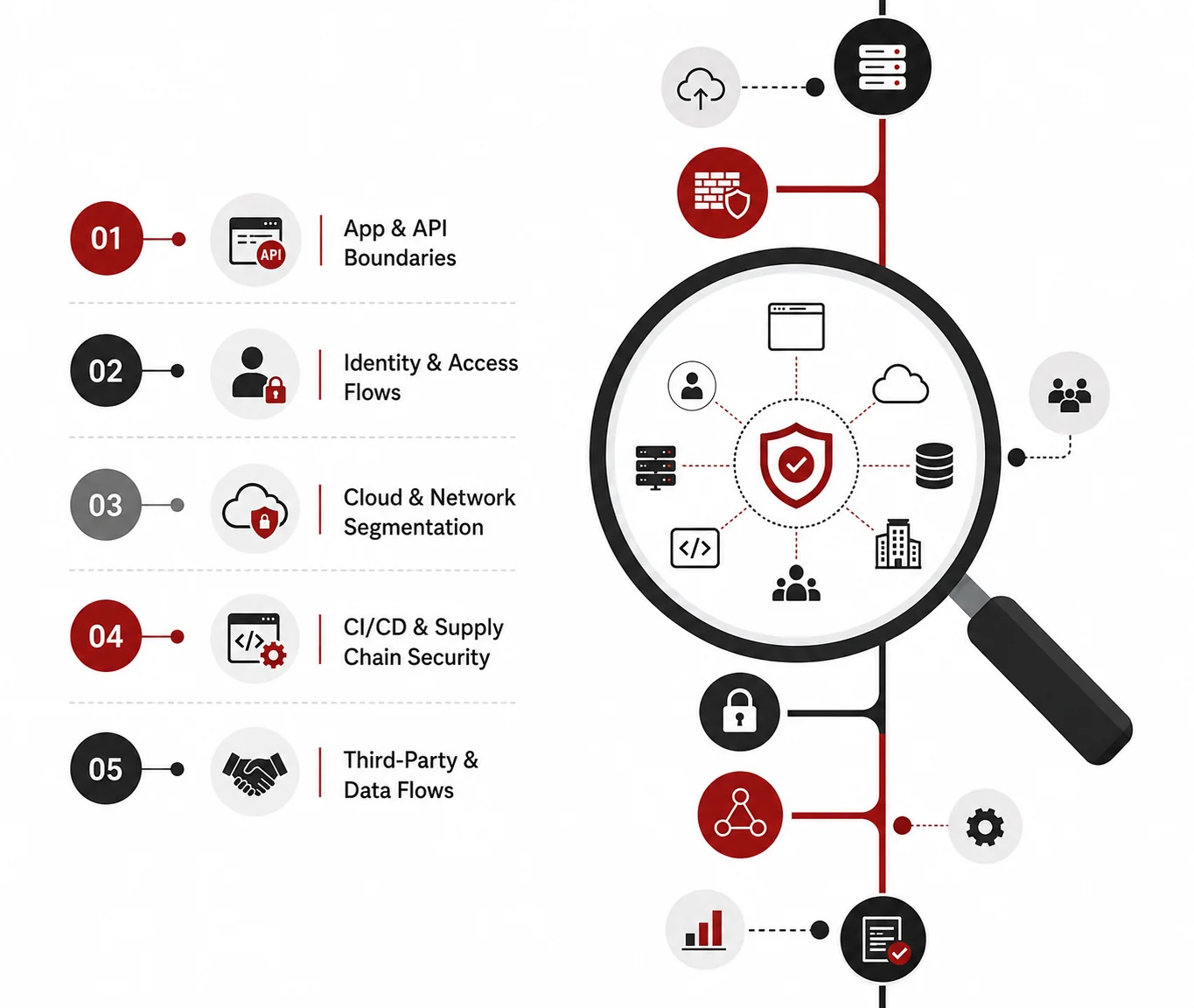
IT risk rarely stays inside one system. Customer applications connect to APIs; APIs connect to services and data; developers connect to CI/CD platforms; employees connect to enterprise infrastructure; and cloud environments connect to third-party services.
Security architecture review helps identify weak trust boundaries, unnecessary exposure, excessive privileges and control gaps before they become exploitable attack paths.
- Application, API and microservice trust boundaries
- Identity, privileged access and authentication flows
- Cloud architecture, network segmentation and exposed services
- CI/CD, dependencies, secrets and software supply-chain controls
- Third-party integrations, data flows and business-critical dependencies
Cybersecurity Compliance in the IT Industry
Requirements vary by business model, customer commitments, geography, data handled and services provided. A practical program maps applicable requirements to technology controls, evidence and measurable remediation.
Information security management, risk treatment, controls, governance and continual improvement.
Security and related control considerations for technology and SaaS organizations where applicable.
Indian cybersecurity and incident-related requirements that may apply depending on organizational context.
Privacy and personal-data protection considerations relevant to organizations processing digital personal data.
Application, API and mobile security practices that can inform technical security testing and secure development.
Practical safeguards that can support security prioritization and enterprise control improvement.
Risk-management concepts and security practices useful for technology and enterprise environments.
Security questionnaires, contractual controls, supplier requirements and customer-specific assurance needs.
From Security Gaps to Business Outcomes
A useful cybersecurity engagement should do more than produce a vulnerability list. It should help technology and IT leaders understand what matters, what can be exploited, what should be fixed first and how improvement can be validated.
Reduce Attack Surface
Identify exposed assets, unnecessary services, vulnerable pathways and weak configurations.
Protect Digital Products
Strengthen applications, APIs, mobile products, SaaS platforms and supporting technology.
Improve Security Visibility
Build better visibility across identities, infrastructure, applications, cloud and security operations.
Strengthen Trust & Compliance
Map security improvements to applicable customer, contractual, privacy and compliance expectations.
Security Approach & Methodology
A structured engagement connects scope, discovery, assessment and controlled validation with practical remediation and revalidation.
Scope
Define systems, applications, environments, stakeholders and rules of engagement.
Discover
Identify assets, technologies, connectivity, identities and potential attack surfaces.
Assess
Evaluate vulnerabilities, controls, architecture and security maturity.
Validate
Perform controlled testing and validate exploitable weaknesses where authorized.
Improve
Prioritize remediation and validate that security improvements address material risk.
Why Choose Varutra?
Varutra brings technology-focused cybersecurity assessment and advisory to help organizations understand exposure, prioritize remediation and strengthen security over time.
Vulnerabilities Identified
Security findings identified through authorized assessment and testing engagements.
Clients Supported
Experience supporting organizations with cybersecurity assessment and risk-reduction needs.
Certified Professionals
Our cybersecurity team brings certified expertise across security testing, risk assessment, compliance and cyber resilience.
Industry Experience
14+ years of experience delivering cybersecurity services across diverse technology and business environments.
Frequently Asked Questions
Clear answers about cybersecurity for technology companies, IT services, ITES organizations, SaaS businesses and digital enterprises, including VAPT, application security, API security, cloud security and compliance.
Varutra provides cybersecurity services for technology companies, IT service providers, ITES organizations, SaaS businesses and digital enterprises. Services include cyber risk assessment, vulnerability assessment and penetration testing (VAPT), web and mobile application security, API security testing, cloud and infrastructure security, IoT security, red teaming, threat intelligence, SOC and managed security, incident response, GRC, security awareness and virtual CISO services.
VAPT for technology and software companies can assess internet-facing infrastructure, internal networks, web applications, mobile applications, APIs, authentication and authorization, cloud assets and other systems within an approved testing scope. Vulnerability assessment identifies security weaknesses, while penetration testing validates whether vulnerabilities can be exploited and evaluates their potential business impact through controlled testing.
Application security testing evaluates web and mobile applications for vulnerabilities affecting authentication, authorization, access control, input validation, business logic, session management, sensitive data exposure and other security weaknesses. For IT and SaaS companies, application security testing can help identify and prioritize risks before they affect customers, users or business operations.
API security testing evaluates APIs and connected services for weaknesses involving authentication, authorization, access control, input validation, business logic, rate limiting and sensitive data exposure. For technology and SaaS companies, API security testing helps identify risks across the interfaces that connect applications, users, services and data.
SaaS and cloud companies can improve cybersecurity by assessing cloud configurations, identity and access management, exposed services, application and API security, tenant isolation, data protection, logging and monitoring, containers and third-party integrations. Regular security assessments can help identify weaknesses across cloud infrastructure and technology environments.
Common cybersecurity risks for Technology, IT and ITES organizations include application vulnerabilities, API abuse, credential theft, identity and privilege misuse, cloud misconfiguration, exposed infrastructure, ransomware, software supply-chain compromise, insecure remote access, data exposure, insider risk, third-party compromise and weaknesses across rapidly changing technology environments.
Applicable cybersecurity and compliance requirements depend on an organization's services, customers, data, geography, contractual obligations and industry. Technology, IT and ITES organizations in India may consider ISO/IEC 27001, SOC 2 where relevant, applicable CERT-In requirements, the Digital Personal Data Protection framework where applicable, contractual security requirements and customer-specific security standards. Organizations serving regulated sectors may also need to address additional sector-specific requirements.
Secure Your Technology Environment
Discuss your Technology, IT or ITES cybersecurity requirements with Varutra and identify the right assessment, testing, monitoring, compliance or strategic security approach for your applications, APIs, cloud environments, infrastructure, development lifecycle and critical services.