

Cybersecurity Services for Financial Sector
Financial institutions operate in a highly regulated and increasingly sophisticated threat landscape, where protecting customer data, digital assets, transactions, and critical systems is paramount. Varutra delivers comprehensive cybersecurity services tailored to the financial sector, helping banks, NBFCs, fintechs, insurers, and financial service providers identify vulnerabilities, strengthen resilience, meet regulatory requirements, and stay ahead of evolving cyber threats.
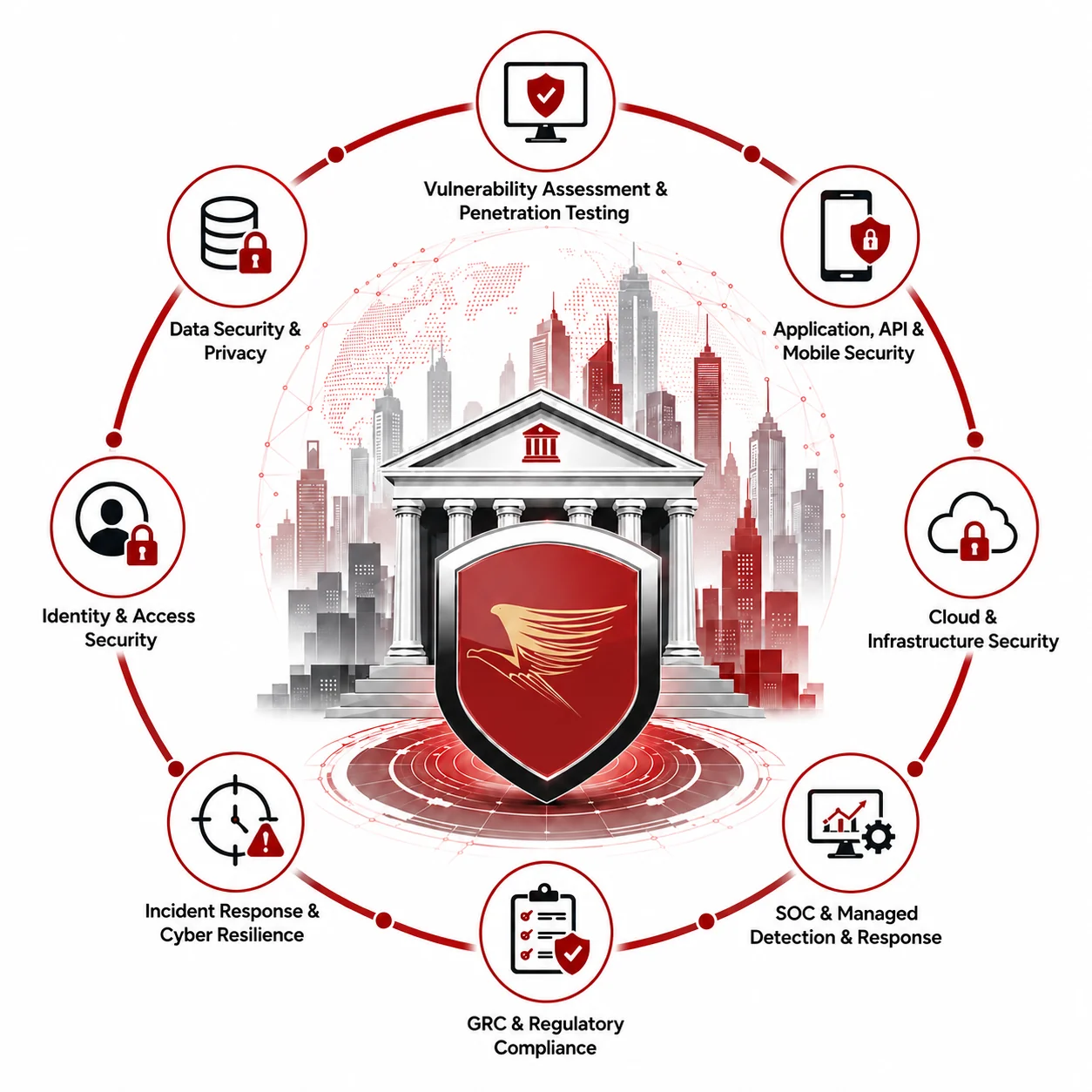
Securing each Finance sector
Explore the financial services organizations we support.
Banking
Public, private, foreign, small finance, payments and cooperative banks
NBFC & Lending
NBFCs, HFCs, microfinance institutions and digital lenders
Insurance
Life, general, health, reinsurance, brokers and InsurTech
Capital Markets
Exchanges, brokers, AMCs, AIFs and investment firms
Payments & FinTech
UPI, wallets, payment gateways, aggregators and FinTechs
Wealth & Asset Management
Wealth managers, portfolio managers and mutual funds
Pension & Retirement
Pension funds, NPS ecosystem and annuity providers
Financial Infrastructure
Credit bureaus, depositories, custodians, KYC and data providers
BFSI cybersecurity protects the technology, data and digital services that enable financial institutions to operate securely.
BFSI cybersecurity covers the security of banking systems, financial applications, payment platforms, APIs, mobile channels, cloud services, networks, endpoints, identities, data and third-party technology. The objective is to identify and reduce cyber risk while supporting availability, confidentiality, integrity and business continuity.
Effective financial-sector cybersecurity combines security testing, governance, continuous monitoring, vulnerability management, incident response, and regulatory compliance. Varutra helps financial organizations strengthen cyber resilience, protect critical systems and data, manage evolving threats, and align security programs with applicable regulatory requirements.
Financial institutions operate highly connected digital services and process sensitive financial and customer information. Cybersecurity helps reduce the risk of unauthorized access, data compromise, fraud, service disruption and attacks against applications, APIs, cloud platforms and enterprise infrastructure.
Key Cyber Risks Across Financial Services
Financial-sector attack paths can cross digital channels, identities, applications, infrastructure, cloud services, third parties and human users. Security testing and monitoring should reflect those relationships.
Identity & Account Takeover
Credential theft, weak authentication, session abuse and privilege misuse can expose customer and enterprise accounts.
Application & API Attacks
Web applications, mobile backends and APIs can expose authentication, authorization, business logic and data security weaknesses.
Cloud & Configuration Risk
Misconfiguration, excessive privileges, exposed services and insecure workloads can increase the attack surface of financial platforms.
Infrastructure Exposure
Internet-facing assets, networks, endpoints and remote-access paths can provide opportunities for initial access and lateral movement.
Third-Party & Supply Chain
Service providers, technology partners and integrations can introduce dependencies that need security and risk oversight.
Operational Disruption
Ransomware, destructive attacks and security incidents can affect availability, customer services, operations and recovery objectives.
The Technology Behind Modern Financial Services
BFSI security assessments can be scoped across the technology layers that support digital banking, lending, payments, insurance, investments and financial operations.
Core & Enterprise Banking
Business applications, internal platforms, infrastructure and privileged access supporting financial operations.
Mobile Banking
Mobile applications, authentication flows, backend services and security-sensitive transaction functions.
Internet-Facing Applications
Customer portals, web applications and public-facing services exposed to external users and threats.
APIs & Integrations
Financial APIs, partner integrations and service-to-service communication paths.
Payments & Transaction Platforms
Payment-related technology, transaction workflows and supporting security controls within approved scope.
Cloud & SaaS
Cloud infrastructure, workloads, identities, storage, configurations and connected services.
Networks & Endpoints
Network architecture, segmentation, servers, endpoints and remote-access technologies.
Data & Identity
Sensitive data stores, access controls, identity services and security boundaries around critical information.
Our Cybersecurity Services for the Financial Sector
Our cybersecurity services are designed to address the unique security, risk, and compliance challenges of the financial sector. From proactive security testing and vulnerability management to continuous monitoring, incident response, governance, and regulatory compliance, Varutra helps financial organizations strengthen their security posture, protect critical assets and customer data, and build resilience against evolving cyber threats.
Connect risk identification with practical security validation.
BFSI security programs benefit when risk assessments, vulnerability discovery and technical testing are connected to remediation, detection and revalidation. Scope can be tailored to the institution's technology architecture and approved testing boundaries.
- Attack-surface and vulnerability assessment
- Controlled penetration testing and security validation
- Application, API, mobile, network and cloud testing
- Detection, remediation prioritization and revalidation
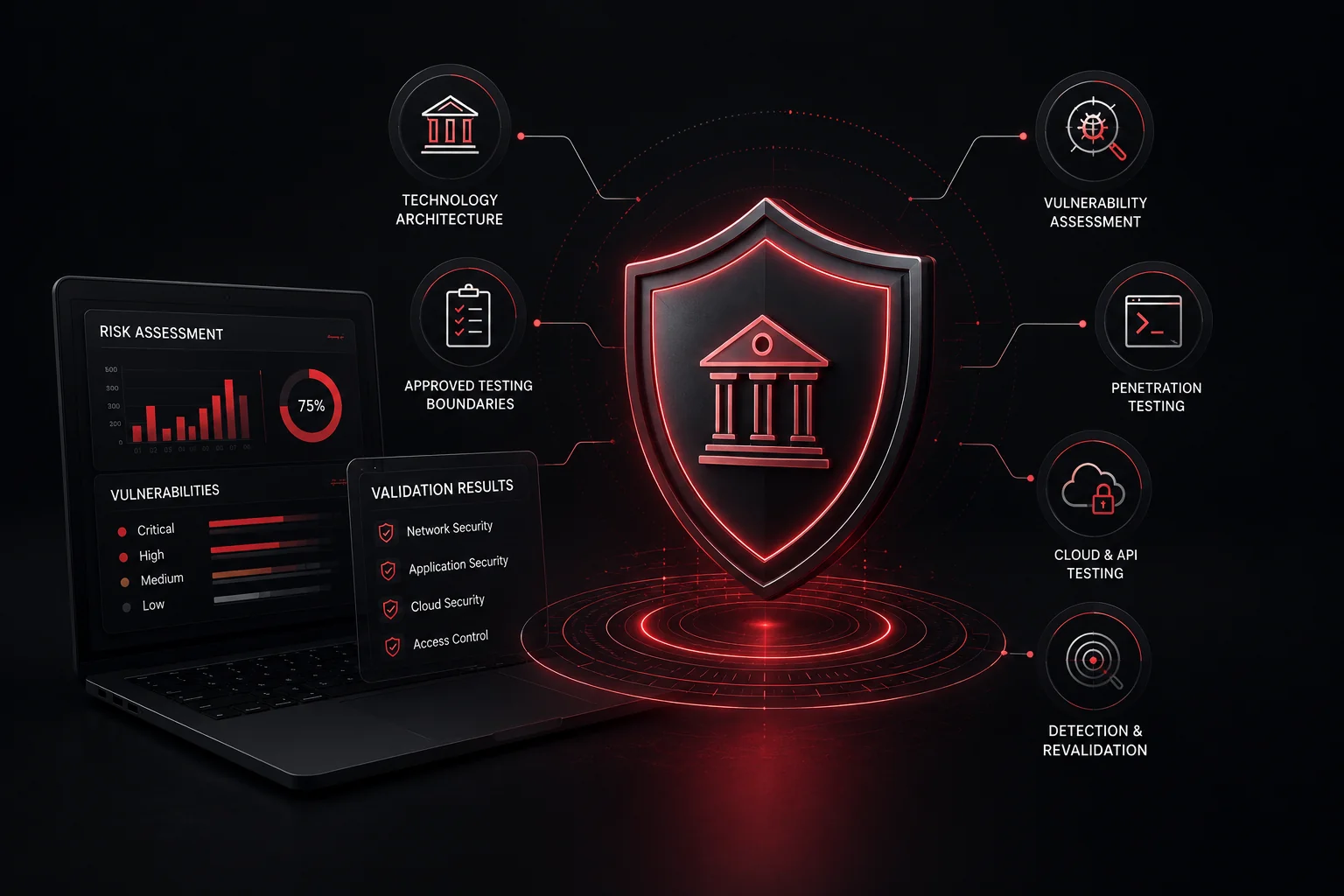
BFSI VAPT & Infrastructure Security
Identify and validate vulnerabilities across banking infrastructure, networks, endpoints and internet-facing financial systems.
- Infrastructure vulnerability assessment and penetration testing
- External and internal network security testing
- Segmentation, remote-access and endpoint security review
- Risk-based remediation and revalidation
Web, Mobile & API Security
Secure digital banking, lending, insurance, payment and fintech applications across web, mobile and API layers.
- Web and mobile application security testing
- API authentication, authorization and access-control testing
- Business-logic, session and data-exposure assessment
- OWASP-aligned security validation
Cloud & Digital Infrastructure Security
Assess cloud environments and connected infrastructure supporting critical financial applications, workloads and data.
- Cloud configuration and workload security review
- Identity, privilege and access assessment
- Cloud network, storage and data-exposure review
- Security architecture across hybrid and connected environments
Red Teaming & Adversary Simulation
Evaluate whether realistic attack paths can reach defined business or security objectives across the financial attack surface.
- Attack-surface reconnaissance and initial access simulation
- Privilege escalation and lateral movement
- Objective-based attack-path validation
- Detection and response effectiveness assessment
Vulnerability & Exposure Management
Turn vulnerability findings into a repeatable risk-based process for financial-sector assets, applications and infrastructure.
- Asset and vulnerability visibility
- Risk-based prioritization and remediation tracking
- Recurring vulnerability identification
- Revalidation, reporting and continuous improvement
SOC, Managed Security & Incident Response
Strengthen continuous monitoring, threat detection and incident response for critical financial systems and digital channels.
- SOC monitoring, alert triage and investigation
- Managed security operations and threat detection support
- Incident readiness, investigation and containment
- Recovery, escalation and lessons learned
Cybersecurity Audit, GRC & Regulatory Compliance
Assess security controls and governance against applicable BFSI requirements, regulatory expectations and organizational policies.
- Cybersecurity audits and control assessments
- RBI, SEBI, IRDAI, CERT-In and applicable requirement alignment
- Gap, risk and evidence assessment
- Remediation roadmap and compliance readiness
Data Privacy, Identity & Security Architecture
Protect sensitive financial and personal data while strengthening identity controls, trust boundaries and security-by-design.
- Data-flow, privacy and protection control review
- DPDP readiness and privacy governance support
- Identity, privileged access and authentication review
- Security architecture and trust-boundary assessment
AI Security
Secure AI applications, models, data, integrations and supporting infrastructure against emerging security risks across financial systems.
- AI application, model and integration security assessment
- AI data security, access-control and privacy review
- AI infrastructure and supporting-system security assessment
- AI-specific threat, risk and attack-surface assessment
Securing the Financial Technology Ecosystem
Financial-sector security is rarely limited to a single application. Customer channels, APIs, identity services, cloud platforms, enterprise networks, data stores and third-party integrations create interconnected trust boundaries.
Security architecture review can help identify control gaps across these boundaries and translate technical findings into practical security improvements.
- Application and API trust boundaries
- Identity, privileged access and authentication flows
- Network segmentation and security zones
- Cloud, data and third-party dependencies
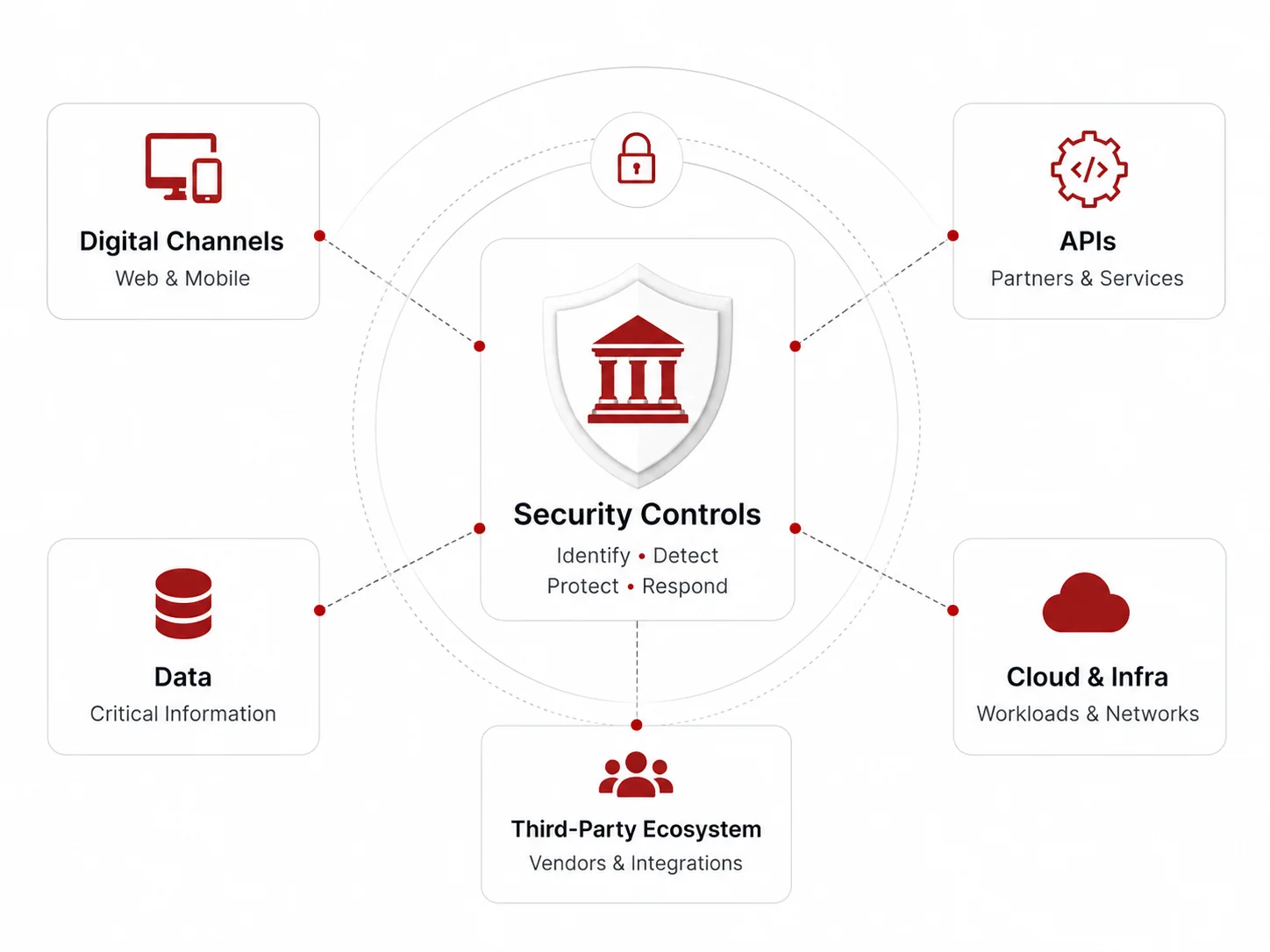
Regulatory and security frameworks that secure the BFSI Industry.
Requirements vary by entity type, service, technology environment and regulatory perimeter. A practical assessment should map the organization's controls and evidence to the requirements that actually apply.
Banks, NBFCs and payment entities may need to consider applicable RBI directions. Securities-market entities may need to consider SEBI's Cybersecurity and Cyber Resilience Framework. Insurers and insurance intermediaries should consider applicable IRDAI information and cyber security requirements. CERT-In directions, privacy obligations and contractual requirements may also apply depending on the organization and service.
IT Governance, Risk, Controls & Assurance
RBI's IT governance direction addresses governance, risk, controls, assurance, IT services and operational resilience for applicable regulated entities.
IT Outsourcing & Third-Party Risk
Applicable RBI outsourcing requirements address governance, risk assessment, service-provider oversight, cloud and managed security arrangements.
Digital Payment Security
RBI has specific cyber resilience and digital payment security directions for applicable payment-system entities.
Cybersecurity & Cyber Resilience Framework
SEBI's CSCRF establishes cybersecurity and cyber-resilience expectations for applicable SEBI-regulated entities.
Information & Cyber Security
IRDAI information and cyber security requirements are relevant to applicable insurers and insurance intermediaries.
Cyber Incident & Security Directions
Applicable CERT-In directions should be considered for incident reporting, logging and other prescribed cybersecurity obligations.
Digital Personal Data Protection
Where applicable, privacy and personal-data obligations should be incorporated into security, governance and data-protection programs.
ISO/IEC 27001 & Other Frameworks
Organizations may also use ISO/IEC 27001, NIST and other recognized frameworks to structure information-security governance and controls.
From Security Findings to Measurable Improvement
The objective is not simply to produce findings. It is to help security and technology teams understand risk, prioritize action and validate improvement.
Understand assets, vulnerabilities, attack paths, dependencies and control gaps across the BFSI environment.
Translate technical findings into risk-based remediation priorities for security and technology teams.
Improve visibility into suspicious activity through monitoring, investigation and response capabilities.
Strengthen the ability to prevent, detect, respond to and recover from cybersecurity incidents.
From Financial Cyber Risk Discovery to Remediation
Engagements can be tailored to the organization's objectives, technology environment, risk profile and approved scope.
Scope
Define critical services, assets, systems, stakeholders and testing boundaries.
Assess
Identify vulnerabilities, architecture gaps, control weaknesses and risk exposures.
Validate
Use controlled security testing to validate material weaknesses and attack paths.
Prioritize
Translate findings into practical risk, remediation and governance priorities.
Improve
Support remediation, revalidation and continuous security improvement.
Cybersecurity expertise for complex financial environments.
Varutra brings broad cybersecurity expertise across financial-sector applications, APIs, cloud environments, infrastructure, data and connected digital ecosystems.
Financial-Sector Expertise
Security expertise spanning banking, NBFC, fintech, insurance, payments and capital-market technology environments.
Risk-Based Security Testing
VAPT and security assessments focused on vulnerabilities, attack paths, business risk and practical remediation.
End-to-End Technology Coverage
Application, API, mobile, cloud, infrastructure, identity, data and third-party security across interconnected environments.
Regulatory-Aware Approach
Security assessments aligned to applicable regulatory, compliance, governance and risk requirements.
Threat-Focused Assessments
Security testing designed to identify realistic attack paths, control weaknesses and exposure across critical assets.
Security Improvement
Actionable findings, remediation guidance and revalidation to help organizations continuously strengthen cyber resilience.
Varutra supports financial organizations with cybersecurity assessment, VAPT, application and API security, cloud security, security operations, compliance, incident response and cyber resilience across complex technology environments.
Frequently Asked Questions
Direct answers about BFSI cybersecurity services, VAPT, financial-sector cyber risks, digital banking security, Indian regulatory requirements and cyber resilience.
The BFSI sector in India needs cybersecurity services to protect applications, APIs, digital channels, infrastructure, cloud environments, data, and third-party ecosystems. Key services include VAPT, application and API security testing, cloud and infrastructure assessments, red teaming, security monitoring, incident response, regulatory compliance, and cyber resilience.
Banks, NBFCs, fintechs and insurers typically need cybersecurity services that address their applications, APIs, mobile channels, networks, cloud environments, endpoints, identities, data and third-party connections. Depending on the organization's risk profile and technology environment, this may include VAPT, application and API security testing, infrastructure security, cloud security, red teaming, SOC and managed security, cybersecurity audit and GRC, incident response and security architecture assessments.
BFSI VAPT is vulnerability assessment and penetration testing performed against financial-sector technology within an authorized scope. Depending on the organization's environment, testing can cover internet-facing infrastructure, networks, web applications, mobile applications, APIs, authentication and access controls, selected cloud environments and other critical systems. Vulnerability assessment identifies security weaknesses, while penetration testing validates whether identified weaknesses can be exploited and what business risk they may create.
Major cybersecurity risks for financial institutions include credential theft, account takeover, phishing and social engineering, ransomware, web and API attacks, insecure authentication and authorization, cloud misconfiguration, exposed infrastructure, data exposure, insider risk, third-party compromise and operational disruption. Financial institutions should assess these risks across digital channels, identities, applications, infrastructure, cloud services, data, employees and technology partners.
Applicable cybersecurity requirements depend on the type of financial organization, services provided and regulatory classification. Banks, NBFCs and applicable payment entities may need to consider relevant RBI directions and cybersecurity requirements. Securities-market entities should consider applicable SEBI cybersecurity and cyber resilience requirements. Insurers and insurance intermediaries should consider applicable IRDAI information and cybersecurity requirements. CERT-In directions and applicable privacy, technology, incident reporting and sector-specific obligations may also be relevant. Organizations should assess the requirements applicable to their specific business and technology environment.
Banks and financial institutions should assess APIs, mobile applications, cloud environments and infrastructure as connected parts of the financial technology ecosystem. Security testing can examine authentication, authorization, session management, business logic, input validation, data exposure, rate controls and access controls in APIs and applications, while infrastructure and cloud assessments can identify exposed services, insecure configurations, excessive privileges and weaknesses that could enable unauthorized access or lateral movement.
Financial institutions can improve cybersecurity and cyber resilience by identifying critical assets and services, assessing technology and third-party risks, testing applications and infrastructure, remediating security weaknesses, strengthening security monitoring and incident response, and periodically validating controls through audits and revalidation. Aligning security activities with applicable regulatory requirements and maintaining clear ownership, remediation tracking and continuous risk visibility can help turn cybersecurity findings into measurable security improvements.
Strengthen your Financial Cyber Resilience
Discuss your BFSI cybersecurity requirements with Varutra and identify the right assessment, testing, monitoring, compliance or response approach for your applications, APIs, mobile channels, infrastructure, cloud environments and critical services.