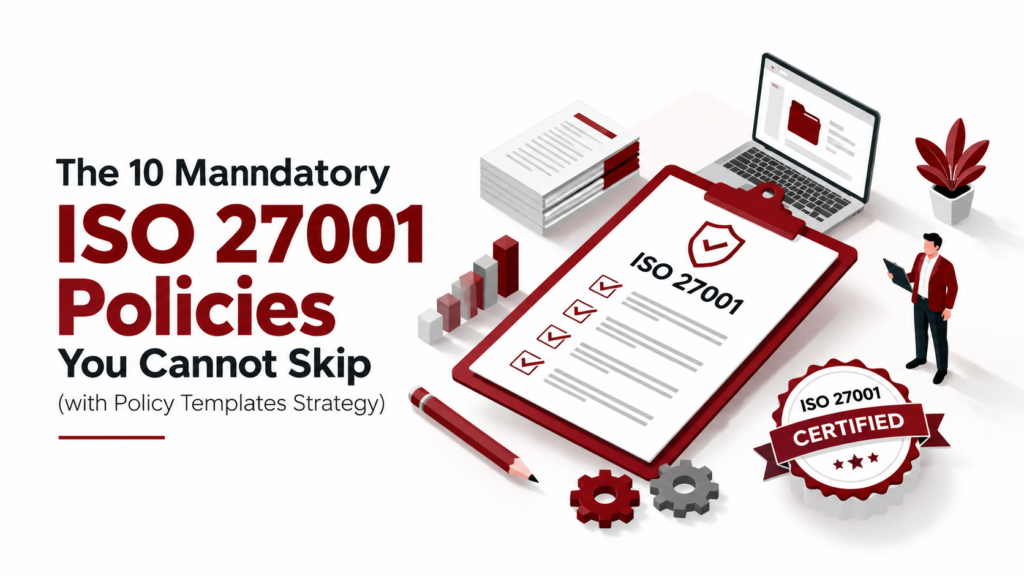

The 10 Mandatory ISO 27001 Policies You Cannot Skip (with Policy Templates Strategy)
Clear information security policies help organizations establish responsibilities, manage risks, and support an effective Information Security Management System (ISMS). For businesses pursuing ISO/IEC 27001:2022 certification, policies should reflect the organization’s actual activities, risks, and scope—not simply rely on generic templates.
This guide introduces common policy areas organizations may need to consider during their ISO 27001 compliance journey.
Why Are Policies Important for ISO 27001?
Information security policies communicate management expectations, guide employees, and help demonstrate how an organization manages information security. Their content and supporting documentation should be appropriate to the organization’s ISMS scope and applicable requirements.
Common ISO 27001 Policy Areas
The following areas are commonly considered when developing an ISO 27001-aligned policy framework. The exact policies and documented information needed depend on the organization’s context, risks, and selected controls; this is not a universal list of ten separately mandated documents.
- Information Security Policy: Sets the organization’s overall direction and commitment to information security.
- Access Control: Establishes principles for granting, reviewing, and removing access to information and systems.
- Information Classification and Handling: Guides the appropriate handling and protection of information.
- Incident Management: Defines how information security events and incidents are reported and managed.
- Business Continuity and Recovery: Supports the protection and availability of information during disruptions.
- Supplier and Third-Party Security: Addresses information security risks associated with vendors and service providers.
- Cryptography: Establishes when and how cryptographic protection is used, where applicable.
- Secure Development and Change Management: Addresses security considerations in development and system changes, where relevant.
- Asset Management and Acceptable Use: Supports accountability for information assets and their appropriate use.
- Physical and Environmental Security: Addresses risks to facilities, equipment, and physical access.
What Makes an ISO 27001 Policy Effective?
Policies should be clear, approved by the appropriate authority, communicated to relevant personnel, and reviewed when business needs or risks change. They should reflect actual practices and be supported by appropriate evidence. Generic templates may provide a starting point, but they should be assessed and tailored to the organization.
How Varutra Can Help
Varutra helps organizations assess their ISO 27001 compliance needs and plan a practical path toward audit readiness. Support can be tailored to the organization’s scope, existing controls, and business requirements.
Preparing for ISO 27001 certification? Contact Varutra to discuss your information security and compliance objectives.
Frequently Asked Questions About ISO 27001 Policies
1. What policies are required for ISO 27001?
ISO/IEC 27001:2022 explicitly requires an information security policy. Other policy documents depend on the organization’s risks, ISMS scope, and applicable controls; there is no universal requirement to maintain exactly ten separately named policies.
2. Are ISO 27001 policy templates acceptable?
Templates can help structure documentation, but they should be adapted to the organization’s activities, responsibilities, risks, and actual processes. A generic, unreviewed template may not accurately demonstrate how security is managed.
3. What is the difference between an ISO 27001 policy and a procedure?
A policy sets expectations, principles, and rules. A procedure explains how a specific activity is carried out. Organizations may need both, depending on their processes and the evidence required to support their ISMS.
4. How often should ISO 27001 policies be reviewed?
Policies should be reviewed at planned intervals and when significant changes, incidents, or risks make a review necessary. The appropriate review schedule should fit the organization’s governance arrangements and applicable requirements.
5. Do small businesses need ISO 27001 policies?
Small businesses pursuing ISO 27001 need an ISMS appropriate to their scope and risks, including relevant policies and documented information. The framework can be scaled to the organization rather than copied from a larger enterprise.
Further Reading
ISO/IEC 27002:2022 — Information Security Controls | ISO
ISO/IEC 27000 Family — Information Security Management | ISO
IS/ISO/IEC 27001:2022 — Information Security Management Systems | BIS